Selecting an Immediate Annuity in Retirement
By Henry K. (Bud) Hebeler
4/15/05
I recently decided to investigate whether to invest $100,000 in an inflation protected immediate annuity or a fixed payment immediate annuity, or not to buy an annuity at all. In order to do this, I built a computer model that compares these three cases as well as immediate annuities that increase a fixed percentage each year. They may be in qualified or non qualified accounts. The program is a free download on www.analyzenow.com.
For my purpose, I was interested in a non qualified annuity which means that tax rates may well be significantly different late in life than after I first start getting payments due to the fact that non qualified annuities have a tax exclusion that applies until the sum of all of the previous years’ tax exclusions exceeds the original total investment.
Also, for this particular case, I decided to analyze fixed payment annuities on the basis that I would save part of the after-tax fixed payment each year so that it could be drawn down in subsequent years to offset inflation. Roughly, this means that I can spend only a fraction of this fixed payment that is equal to my age at the time divided by 100, so that, at my current age of 72, I could spend about 72% of the after-tax amount this year and save 28%. If you select this option on the program, it actually uses a fraction that is dependent on the more accurate ratio of two financial payment equations where the payment in the numerator is based on the real return and life-expectancy and the payment in the denominator is based on the actual return and life-expectancy.
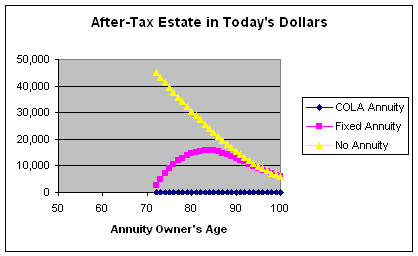
Of course, one of the most serious limitations of an immediate annuity is that once committed, there is nothing left for heirs after the second death. Figure 1 shows the after-tax estate value for all three cases should the 55% estate tax be in place at the survivor’s death. Today’s values are based on an assumed long-term inflation rate of 4%. Also, I used long-term tax rates of 40% for ordinary income and 30% for the returns on investments. Considering that my wife has longevity in her family and that the present value (today’s dollars) is so low late in life, preservation of capital for heirs is not an important consideration. If it were, I would not select an annuity.
Figure 1. After-Tax Estate Values for Nominal Conditions
Another important consideration is selection of a survivor’s benefit. Most simplified annuity analyses do not account for this, but it’s very important to include what may be necessary for the surviving spouse’s subsistence. In our own case, I chose 75% because 50% turns out to be closer to 40% after the tax exclusion ends, and it’s hard to sell a spouse on subsisting with only 40% of the income when I was living. I got the annuity quotes for all cases from www.vanguard.com which is a competitive source.
Figure 2 illustrates the results if the actual inflation is 4% and returns are 5%, and the projection for each year is based on the same values. (I used a 5% return to represent the replacement of part of my fixed income investments.) Some will be surprised that the "No Annuity" case shows a continued reduction in spending capability, but that’s what really happens if you do a new projection each year and account for the expected increase in the age to die the longer we live. In this example, I assumed that we would always add five years to the life-expectancy at any age of the planning forecast in order to have a plan that would support living longer than the average person’s life-expectancy.
Figure 2. Nominal Case If Inflation Is 4% and I Die at 86
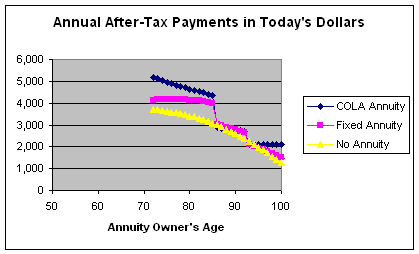
In the nominal case above, the immediate cost-of-living-adjusted (COLA) annuity is probably the best choice, but all three alternatives provide small compensation after age 92. Next we have to ask what happens under other economic and age possibilities?
Coffin Corners: Coffin corners are combinations of reasonable economic and age extremes. I chose these corners as represented by 2% inflation with death at 76 (Figure 3), 2% inflation with death at 96 (Figure 4), 6% inflation with death at 76 (Figure 5), and 6% inflation with death at 96 (Figure 6).
In the 2% inflation corners, the "No Annuity" selection is the best alternative if I would die at age 76 (Figure 3) both from the standpoints of annual income as well as the residual estate. On the other hand, if I would live to age 96 (Figure 4) just as my father, I would be better off with the fixed annuity if I would continue to spend only part of the after-tax fixed annuity each year, e.g., a fraction about equal to Age/100.
The potential of 6% inflation is an important consideration in my case because I’m concerned about abnormally high future inflation and want some inflation protection for some of my fixed income investments. If I would die as early as 76 (Figure 5), it would be best to select the inflation protected annuity if estate considerations aren’t important.
Figure 3. 2% Inflation, Die at 76
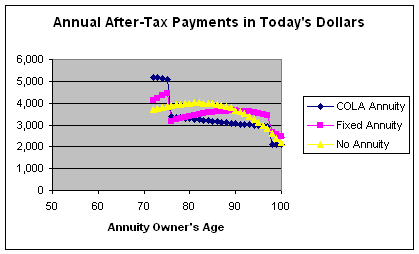
Figure 4. 2% Inflation, Die at 96
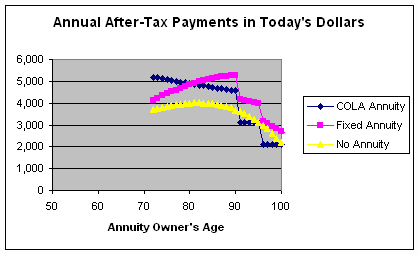
Figure 5. 6% Inflation, Die at 76
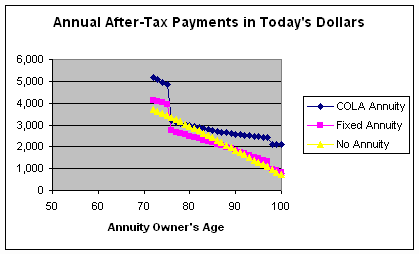
For the two us together, the most important case would normally be the 6% inflation with my death at 96 (Figure 6). In this case, both fixed and inflation-adjusted annuities suffer a severe tax increase at age 91 due to the tax exclusion having run its course. In this case, the inflation-adjusted annuity is again the best choice.
Figure 6. 6% Inflation, Die at 96
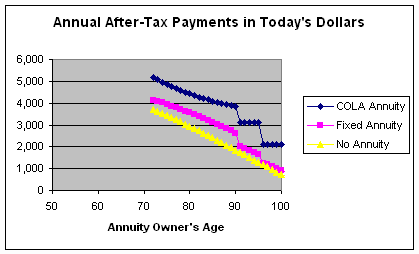
Of course, I can’t tell which situation is more likely to be nearer what will actually happen in the future. If I base my decision that all four coffin corners plus the nominal case have an equal probability, I would choose the inflation protected annuity first, the fixed payment annuity as second choice, and the self administered funds as the last choice. Further, the inflation protected annuity complements a substantial fixed payment annuity in the form of my Boeing pension. Thus, the COLA annuity benefits from high inflation and my pension benefits from low inflation.
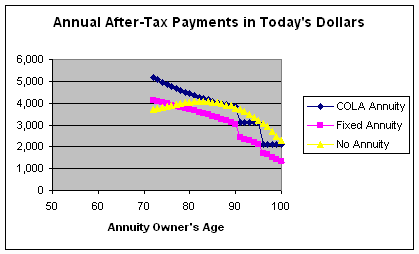
It is interesting to see how the case in Figure 6 would look if I was comparing annuities with an all stock portfolio with a before-tax return of 11% after costs. Surprisingly, the COLA annuity still looks like the best choice if estate values aren’t important. See Figure 7.
Figure 7. 6% Inflation, Die at 96, and 11% Return
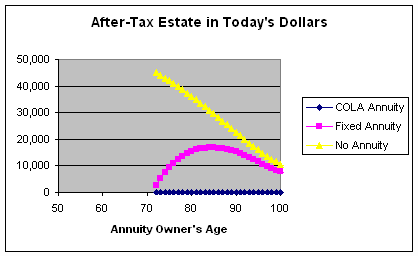
Of course, at such high returns on investment, you would probably want to consider the estate value for heirs. The corresponding estate values are shown in Figure 8. From an estate consideration, the 11% return case is not hugely different from the case with 5% return case because so much more has been withdrawn.
Figure 8. Estate Values for 6% Inflation, Die at 96, and 11% Return
Those of you who are considering buying an immediate annuity for retirement may want to go through the same kind of analysis using the free program "Evaluating Immediate Annuities" that you can download from www.analyzenow.com. You could well arrive at different conclusions depending on a number of things including your age now, whether your investment will be in a qualified account, the survivor benefit percentage you choose with the corresponding quotes, your outlook for returns, inflation, and tax rates, and whether your estate values are significant. It’s important to develop some perspective by examining results for expected and "coffin corner" examples.
Finally, remember that the results will depend on the competitiveness of your annuity quotes. Insurance products can be very costly, so quotes will vary widely.